
The People Who Opened the Door
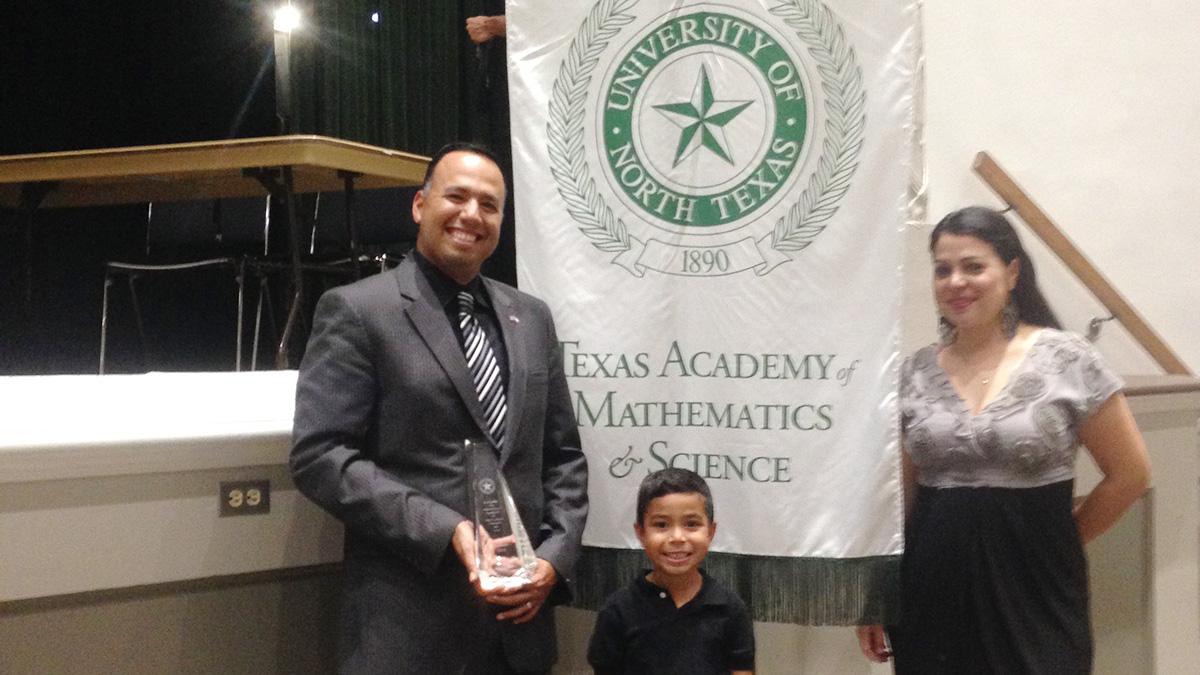
Mentors at UNT helped shape one student’s path from a small Texas Town to education leadership, and now he’s helping students across North Texas find their own.
The town of La Villa sits deep in South Texas, in the Rio Grande Valley, where most graduating classes are small and many families have known one another for generations.
David Saenz grew up there in a class of about fifty students. His mother raised three boys on her own, and education carried real weight in their household. She had earned her master’s degree while pregnant with him — something she liked to remind him of when school felt difficult.
“She’d say, ‘You already have a master’s degree. You were there when I got it,’” he remembers.
Hard work came earlier still. Saenz spent time in the fields with his grandfather, picking cucumbers and watermelons under the South Texas sun. His grandfather believed deeply in honest work — but he believed just as strongly that education could change a family’s future.
Saenz was a strong student in his small school, but like many rural students, he began to realize early that opportunity often depends on where you live. That realization sharpened when he attended a summer academic program in the Valley and heard visitors from the University of North Texas describe something he had never imagined.
The Texas Academy of Mathematics and Science. A residential program where high-achieving high school students could complete their final two years of high school while taking college courses at UNT.
“I knew that day that I wanted to go,” Saenz says. “The real question was whether I’d be able to make it.”
A Door That Almost Closed
TAMS applicants were expected to arrive with advanced math coursework already completed — classes Saenz’s school simply didn’t offer on the same timeline. So, he doubled up on math classes and gave up varsity football, a difficult decision in a small Texas town where sports often define high school life.
“There were no guarantees,” he says. “But I knew I had to try.”
The application process brought another hurdle. When Saenz arrived to take the SAT — a test he had only recently learned about — he discovered he needed two forms of identification.
He had one. He wasn’t allowed to take the exam.
For many students, that moment might have ended the story. But two people at UNT had taken notice: Dr. Brent Jones and Ray Los Santos, who had visited Saenz’s summer program and recognized his potential. After learning what had happened, they worked with Saenz’s mother to arrange an institutional SAT exam at UNT. Saenz and his mother drove more than ten hours to Denton so he could take the test.
To this day, he doesn’t know what score he received. Only that it was enough.
Learning What It Takes
Arriving at TAMS was at the same time exhilarating and intimidating. Students came from some of the most competitive schools in Texas. Many had taken advanced math courses years earlier. Some placed into college-level classes far beyond what Saenz had studied in his hometown.
For the first time in his life, academics didn’t come easily.
“I didn’t have the study skills,” he says. “I had always done well without really learning how to study.”
Eventually, advisors called him in for a difficult conversation. The program was demanding, and they worried he might struggle to keep up. Saenz understood their concern. But he also knew what it had taken to get there.
“If you’re kicking me out, that’s one thing,” he told them. “But if you’re asking me to leave on my own, I just can’t do it.”
He stayed.
Slowly, with persistence and the support of the people around him, he found his footing. Looking back, he says the most important lessons he learned at UNT had less to do with coursework and more to do with the people who surrounded him.
“They didn’t see me just for the academic side,” he says. “They saw the person that I could be.”
A Different Direction
After graduating from TAMS, Saenz continued his studies at the University of Texas at Austin, initially pursuing aerospace engineering. But while tutoring students in East Austin, he discovered something unexpected: He loved teaching.
Helping students understand difficult ideas — and watching their confidence grow — felt more meaningful than solving equations alone. Eventually, he changed course.
That decision led him into education and, not long after, into leadership. At just 25 years old, Saenz became the principal of Austin Middle School in Irving ISD.
Many of the teachers he supervised had been in the classroom longer than he had been an adult.
Instead of pretending otherwise, he leaned into a simple philosophy.
“You’re the experts,” he told them. “Tell me what you need to do your job well, and I’ll help make it happen.”
It was the same principle he had experienced years earlier at UNT. People succeed when someone believes in them.
Building Pathways
Over the next two decades, Saenz built a career focused on expanding opportunities for students. He served as a principal, district innovation leader and regional collaborator working to connect education with workforce pathways across North Texas.
Today, Saenz serves in a leadership role with the Tarrant To & Through (T3) Partnership, an organization working across Tarrant County to help students chart clear paths from school to career. The work brings together school districts, colleges, employers and community partners to ensure students understand the options available to them — from college degrees to industry credentials and high-demand careers.
Through initiatives like career advising, industry partnerships and regional collaboration, Saenz helps students begin exploring those possibilities as early as middle school. The goal is simple: make sure young people understand what opportunities exist and how to reach them.
“Our job is to show students the opportunities that are out there,” he says, “and help them find the path that fits them.”
Sometimes those connections start with something simple. A conversation. A workplace visit. An introduction to a job students didn’t know existed.
Recently, Saenz helped organize a visit for students to explore careers at American Airlines. Some of the students had never been on an airplane before. Watching them step inside the cockpit of a brand-new aircraft, he says, was a reminder of why the work matters.
“They didn’t know those opportunities were there,” he says. “Now they do.”
The People Who Make a Difference
When Saenz reflects on his own journey, he returns again and again to the people who helped shape it — mentors, teachers and advisors who stepped in at key moments and helped keep doors open.
“They believed in me,” he says.
Today, he sees that same responsibility in his own work. Whether he’s connecting students with internships, introducing them to career pathways or simply encouraging them to pursue opportunities they hadn’t imagined, the goal remains the same: Helping students find their way, one at a time.
Advice for the Next Generation
When Saenz speaks with students today, his advice isn’t complicated. Find your purpose. Surround yourself with people who support you. And don’t be afraid of struggle.
“Do hard things,” he says. “Fail safely. Get back up and try again.”
Because the path forward rarely unfolds exactly as planned. But sometimes one opportunity — and the people who help make it possible — can change everything.
“Maybe one student’s life changes,” he says. “Maybe that one gets their life changed. And that’s enough.”